AIO vs SEO vs GEO vs AEO: which one gets AI to say your name?
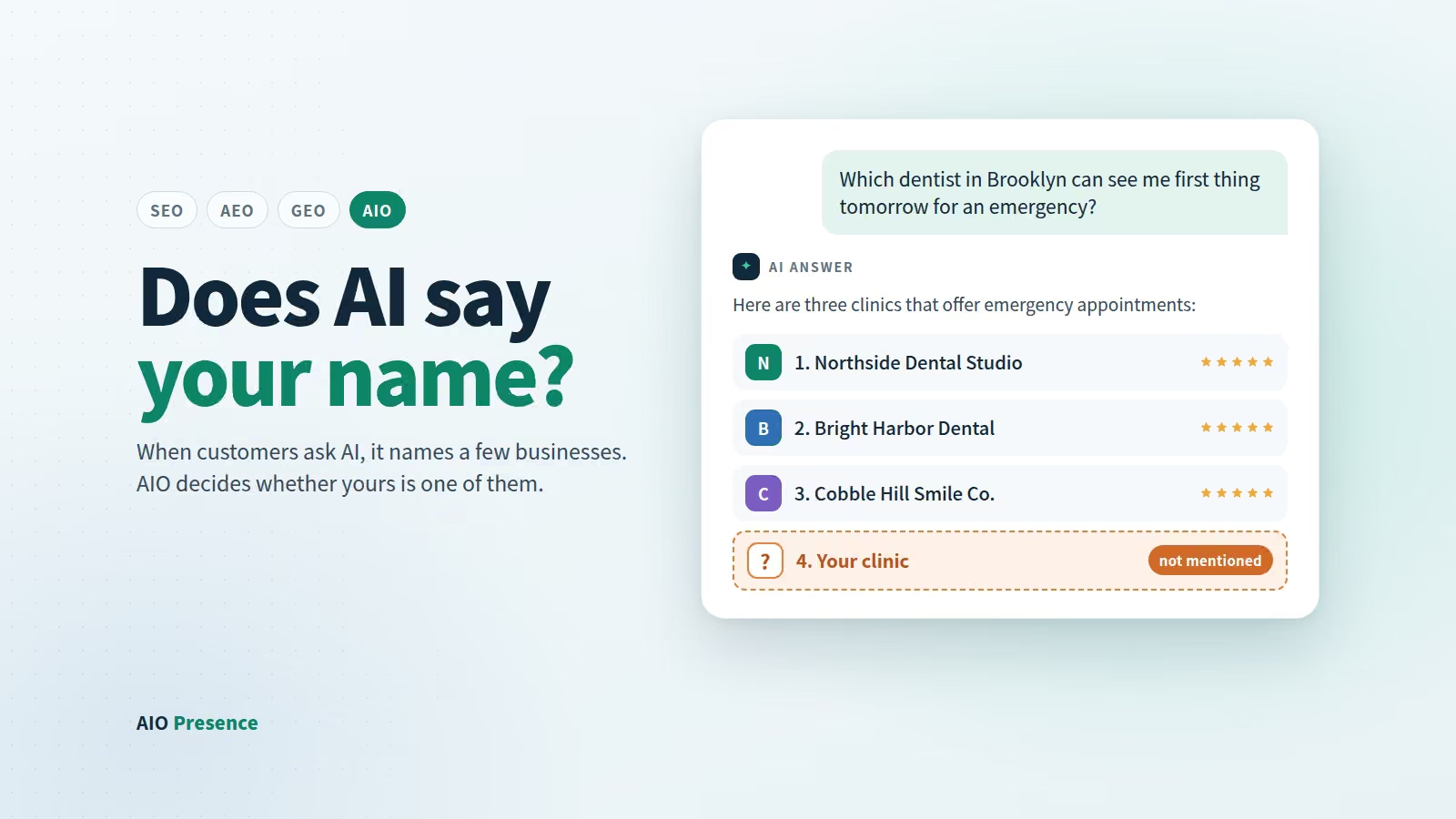
It's 11 p.m. in Brooklyn and Sophia has a toothache that won't wait. She doesn't search "dentist near me" and scroll through results. She opens ChatGPT and asks: "Which dentist in Brooklyn can see me first thing tomorrow for an emergency?" It names three clinics. Yours isn't one of them.
Your clinic has a 4.8-star rating, a decent website and a first-page Google ranking. None of it mattered. Sophia never saw a results page. She booked with clinic number one.
Four acronyms try to explain what just happened: SEO, AEO, GEO and AIO. Here's what each one does, how they differ and which one fixes Sophia's problem.
One verb each
- Goal
- Rank your pages in search results.
- A win looks like
- Position #1 and the click that follows.
- Goal
- Have your content lifted as the direct answer to a question.
- A win looks like
- Your sentence in the featured snippet or voice reply.
- Goal
- Be a source AI quotes when it writes an answer.
- A win looks like
- Your site in the citation links under an AI answer.
- Goal
- Make AI understand your business, trust it and recommend it.
- A win looks like
- Sophia asks, and your clinic is in the answer.
SEO: get found
The foundationSEO makes your website easy for search engines to crawl, understand and rank. It's the oldest of the four, and people keep calling it dead. It isn't. AI answers are built on top of it.
Google says a page has to be indexed and eligible for a search snippet before it can show up as a link in AI Overviews. ChatGPT, Gemini and Perplexity also search the web before they answer. If machines struggle to read your site, you're out before the race starts.
Hudson & Pine, a boutique inn in the Hudson Valley, ranks #2 on Google for "boutique hotel Hudson Valley." Looks fine. But its room rates live inside images, the booking page takes 7 seconds to load on a phone, and the "Amenities" page is a PDF. A person can squint through it. An AI skims it, finds nothing it can quote, and recommends the hotel next door.
This is why website optimization is part of the job, not a side project. Your website is the one source about your business that you fully control. It needs to be:
- Fast, especially on phones.
- Secure, on HTTPS with no broken or mixed content.
- Machine-readable, with real text instead of images of text, a clean page structure and structured data (schema) that spells out who you are, what you do and where.
- Complete: every service, location and price range you want AI to repeat, stated on the page in plain words.
Sometimes a site needs a few fixes. Sometimes it's faster to rebuild it than to patch it.
AEO: be the answer
Question by questionAEO structures your content so a machine can lift one clean answer out of it. It grew up with featured snippets and voice assistants, and it matters even more now that AI answers questions in full sentences.
The rule is simple: put the question in the heading and the answer in the first sentence. Detail comes after.
"At Rivera Plumbing we provide quality plumbing solutions tailored to your needs, backed by years of experience."
Do you unclog drains on weekends in Queens? Yes. We do same-day drain unclogging in Queens seven days a week, and most jobs take under an hour.
The first version says nothing a machine can repeat. The second answers a real question in a sentence an AI can copy word for word. Multiply that across your 20 most common customer questions and you have AEO.
GEO: get cited
Be the sourceGEO gets your content quoted inside answers that AI writes in its own words. The term comes from a 2023 research paper led by Princeton University, which found that adding statistics, quotations and cited sources could make content noticeably more visible in generative answers.
AI cites the page that makes its job easiest: specific, factual and easy to trust.
Two accounting firms in Buffalo write about the same new New York State tax rule. Firm A posts "Big changes are coming. Contact us to learn how they affect you." Firm B posts the three deadlines, who is affected, a worked example for a small shop and a two-line quote from its senior partner. Ask Perplexity about the rule and Firm B is the link under the answer. Firm A doesn't exist.
SEO asks "what's my rank?" GEO asks "am I in the answer at all?"
AIO: get recommended
The whole jobAIO (Artificial Intelligence Optimization) is the practice of making a business understood, trusted and recommended by AI answer systems (Google AI Overviews, ChatGPT, Gemini, Perplexity) and by the web sources those systems rely on.
AIO uses SEO, AEO and GEO, and adds the part none of them covers well: your business as a whole, across the web. AI doesn't recommend a page. It recommends a business, and before it does, it checks what everyone else says about you.
You may also see "AIO" used for optimizing your marketing with AI, such as automated ad bidding and audience targeting. That's a different discipline. This article is about being recommended by AI.
Say the same thing everywhere
AI reads you like a reference checker. It compares your website with your Google Business Profile, LinkedIn, Instagram bio, directory listings, reviews and press mentions. When the stories match, it speaks about you with confidence. When they don't, it hedges, gets you wrong or skips you.
Ferrante & Cole is an employment law firm in Manhattan. Here's what the web says about it:
Ask Gemini for "a lawyer for a wrongful termination case in NYC" and it has four versions of Ferrante & Cole to choose from. It picks a firm with one clear story instead. Fixing this costs almost nothing, and nothing else in AIO pays back as fast.
One business, one description, one set of facts, on every channel you control and as many as you can influence.
AIO is the building. The rest are the parts.
Skip the foundation and nothing above it holds. Skip the pillars and you rank but never get mentioned. You need all of it working together.
What is AIO presence?
AIO presence is how visible, accurate and recommended a business is across AI-generated answers. AIO is the work. AIO presence is the result you can measure.
You measure it with three questions, asked over the real questions customers put to AI:
- Are you mentioned? Out of 10 customer questions, how many answers name you?
- Are you described correctly? Right services, right location, right specialty.
- Are you recommended? Being on a list isn't the same as being the one the AI suggests first.
Sophia's missing dentist, measured
That's a clinic with good reviews and a good ranking, and a weak AIO presence. The scorecard tells you exactly what to fix.
Test, diagnose, implement, monitor
AIO work runs in a loop, because AI answers shift as models, sources and competitors change.
- 1TestAsk Google AI Overviews, ChatGPT, Gemini and Perplexity the questions your customers ask and record who gets named.Visibility Diagnostic
- 2DiagnoseFind why you're missing or misdescribed: an unreadable site, vague content, conflicting facts or too few mentions.Visibility Diagnostic
- 3ImplementFix your website, restructure content around real questions and align your brand across the web.Technical Foundation · Content Structure · Brand & Entity Signals · Website Rebuild
- 4MonitorRe-run the same questions on a schedule, track who gets named and adjust.AI Mention Monitoring
Quick answers
What does AIO stand for in marketing?
Artificial Intelligence Optimization: making a business understood, trusted and recommended by AI answer systems such as Google AI Overviews, ChatGPT, Gemini and Perplexity.
Is AIO the same as GEO?
No. GEO is about getting your content cited. AIO includes GEO and adds your website's technical health, answer-ready content and a consistent message across every channel.
Does AIO replace SEO?
No. AIO depends on SEO. AI systems lean on search indexes, so a site search engines can't read is a site AI can't recommend.
Can a small local business do AIO?
Yes, and it often moves faster than a big brand. A local business answers a narrow set of questions, so clear, consistent facts can take it from absent to mentioned.
How do I know my AIO presence today?
Ask AI the ten questions your customers ask most, in each major assistant. Count how often you're named and check how you're described. Or let me run it for you.